
Bed Bug Exterminator: When to Hire One in Canada and What to Expect
Hiring a Bed Bug Exterminator: Methods, Visits and Licences Explained
In this article
TL;DR
- Call a bed bug exterminator as soon as you confirm live bed bugs. Health Canada strongly recommends a licensed professional pest control operator.
- DIY often falls short: bed bugs and eggs hide where sprays and vacuums do not reach, and bug bombs are ineffective and potentially harmful (UC IPM).
- Expect a mix of methods: most exterminators build a plan around heat or insecticides, then add steam, dusts, encasements and monitoring.
- The job usually runs in this order: inspection, preparation of your home, treatment and at least one follow-up check.
- Eggs are laid in cracks and other hidden locations (Health Canada), so insecticide programs usually take two or three visits, often about two weeks apart. Heat is often one day plus a reinspection.
- Need help? Get a quote from a recommended local exterminator through Pest Agent's referral form.
Spotting a bed bug on a mattress seam forces a quick decision: spend the weekend on sprays and laundry, or call a bed bug exterminator now. The store-bought route feels cheaper, but one female lays at least 200 eggs in her lifetime, and those eggs sit in seams and cracks that a can of spray rarely touches.
Waiting is measured in rooms, not days. Bed bugs confined to one bed are a smaller job than bed bugs that have moved into the couch, the baseboards and the next bedroom. Most people hold off until the bites pile up, which is exactly the delay that turns a one-bed problem into a whole-unit one.
When Do You Need a Bed Bug Exterminator?
You need a bed bug exterminator as soon as you confirm live bed bugs in your home. Health Canada strongly recommends hiring a licensed professional pest control operator, and Quebec's government advises against applying insecticides yourself. The earlier a professional treats, the fewer rooms and belongings are involved.
Signs You Have Bed Bugs
Signs of bed bugs are usually found on or near the bed. Adults are flat, oval and brown, up to 10 mm long, and turn blood red after feeding. Eggs are white and about 1 mm long, so they are very hard to see. Look for live bugs, dark spots on sheets and mattress seams, and pale shed skins. According to UC IPM, most bed bugs are found in or near the bed, so start with the mattress, box spring, bed frame and headboard.
Bites alone are not proof: Health Canada notes that a bite can take up to 14 days to appear, and some people never react. Our guide to the signs of a bed bug infestation shows what to look for, room by room.
Why DIY Treatment Often Falls Short
DIY treatment often falls short because bed bugs and their eggs hide where sprays and vacuums do not reach. UC IPM notes they can squeeze into cracks as small as the width of a credit card, and that total-release foggers (bug bombs) are ineffective and potentially harmful. Health Canada also warns against homemade pesticides, ozone generators and any bed bug product without a PCP registration number on the label.
Home steps still help while you wait for a professional. A hot dryer for 30 minutes or more kills bed bugs in clothing and small items, according to Health Canada, and daily vacuuming reduces their numbers. If you do buy a product, choose one with a PCP number, follow the label exactly and never apply it to bedding or people unless the label allows it. Our review of the best bed bug sprays covers the options sold in Canada.
Pesticide Resistance
Pesticide resistance is a big reason store-bought sprays fail. UC IPM reports that some bed bug populations can no longer be controlled by pyrethroids, a common insecticide group, and University of Kentucky researchers found field bed bugs far more resistant than laboratory strains. Quebec's government adds that misusing insecticides at home can make bed bugs even more resistant to later treatments. A professional can combine products with different modes of action and non-chemical methods such as heat.
If You Rent
If you rent, tell your landlord as soon as you suspect bed bugs. Health Canada and the Quebec government both advise tenants to inform the owner right away so an exterminator can be called. In Quebec, Toronto and British Columbia, the landlord is generally responsible for arranging the treatment, while tenants usually must prepare their unit as instructed. Rules vary by province and city, so check your local tenancy rules before you book and pay for a treatment yourself.
What Bed Bug Treatment Methods Do Exterminators Use?
Bed bug treatment by a professional usually combines several methods, and Health Canada says physical control and preventive measures should be used together. Most exterminators build a plan around heat or insecticides, then add steam, dusts, encasements and monitoring.
Heat Treatment
Heat treatment kills bed bugs and their eggs by raising the temperature of a whole room or unit. Health Canada states that bed bugs die at 50°C, but eggs are tougher: a University of Minnesota study found eggs need more heat than adults to be reliably killed. That is why professional crews often use heaters and fans to bring rooms to about 57 to 60 °C (135 to 140 °F), as described by Orkin Canada (commercial), and hold the heat for hours. UC IPM gives at least 60°C (140°F) for 2 hours, or about 54°C (130°F) for 3 hours.
Health Canada says heat treatments should be left to the professionals. Read more about bed bug heat treatment and how it compares with chemical options.
Insecticide Treatment
Insecticide treatment uses residual sprays and dusts applied to cracks, baseboards, bed frames, outlets and wall voids, which Purdue University Extension describes as places where bed bugs rest, hide or crawl. Health Canada lists liquid sprays, aerosols, insecticidal dusts and diatomaceous earth among the control methods. UC IPM says that, given resistance, insecticides alone will not control an infestation, and Purdue University Extension notes the best programs combine targeted pesticide applications with nonchemical methods. Some products, such as chlorfenapyr, can take many days to kill bed bugs. To learn which active ingredients are used, see what chemicals exterminators use for bed bugs.
Steam Treatment
Steam treatment kills bed bugs and eggs on contact in mattresses, upholstered furniture and bed frames. Health Canada notes that steam cleaners generally emit steam of at least 100°C, well above the 50°C that kills bed bugs. The nozzle has to move slowly so the heat penetrates seams and tufts, and steam leaves no residue, so it is usually paired with a residual product.
Carbon Dioxide Snow
Carbon dioxide snow can freeze bed bugs on contact and is one of the methods Health Canada lists. Some Canadian companies use it under the Cryonite name for electronics and tight spaces where liquids and steam are not suitable (commercial).
Biopesticides
Biopesticides use a living organism instead of a synthetic chemical. Aprehend, made from spores of the fungus Beauveria bassiana, received its PMRA registration in Canada in May 2020 and is generally sold only to pest management professionals. Bed bugs pick up the spores as they walk through treated bands, and companies report residual activity for up to three months (commercial).
Desiccant Dusts
Desiccant dusts such as diatomaceous earth and silica gel destroy the bed bug's protective outer coating so it dries out, according to the US EPA. UC IPM says they can give long-term control when placed in dry, out-of-the-way spots such as wall voids and behind outlet covers, and the US EPA notes they have a long-lasting effect. They work slowly, so professionals use them alongside other methods.
Mattress Encasements
Mattress encasements are zippered covers that seal the mattress and box spring, trapping any bed bugs inside and removing hiding places. Health Canada advises keeping the mattress enclosed for a full year after treatment.
Bed Leg Interceptors
Bed leg interceptors are cups placed under bed and furniture legs that catch bed bugs climbing up or down. In UC IPM research, interceptors trapped many more bed bugs than visual searches alone, which makes them a cheap way to check whether bed bug treatment worked.
What Happens During Bed Bug Extermination?
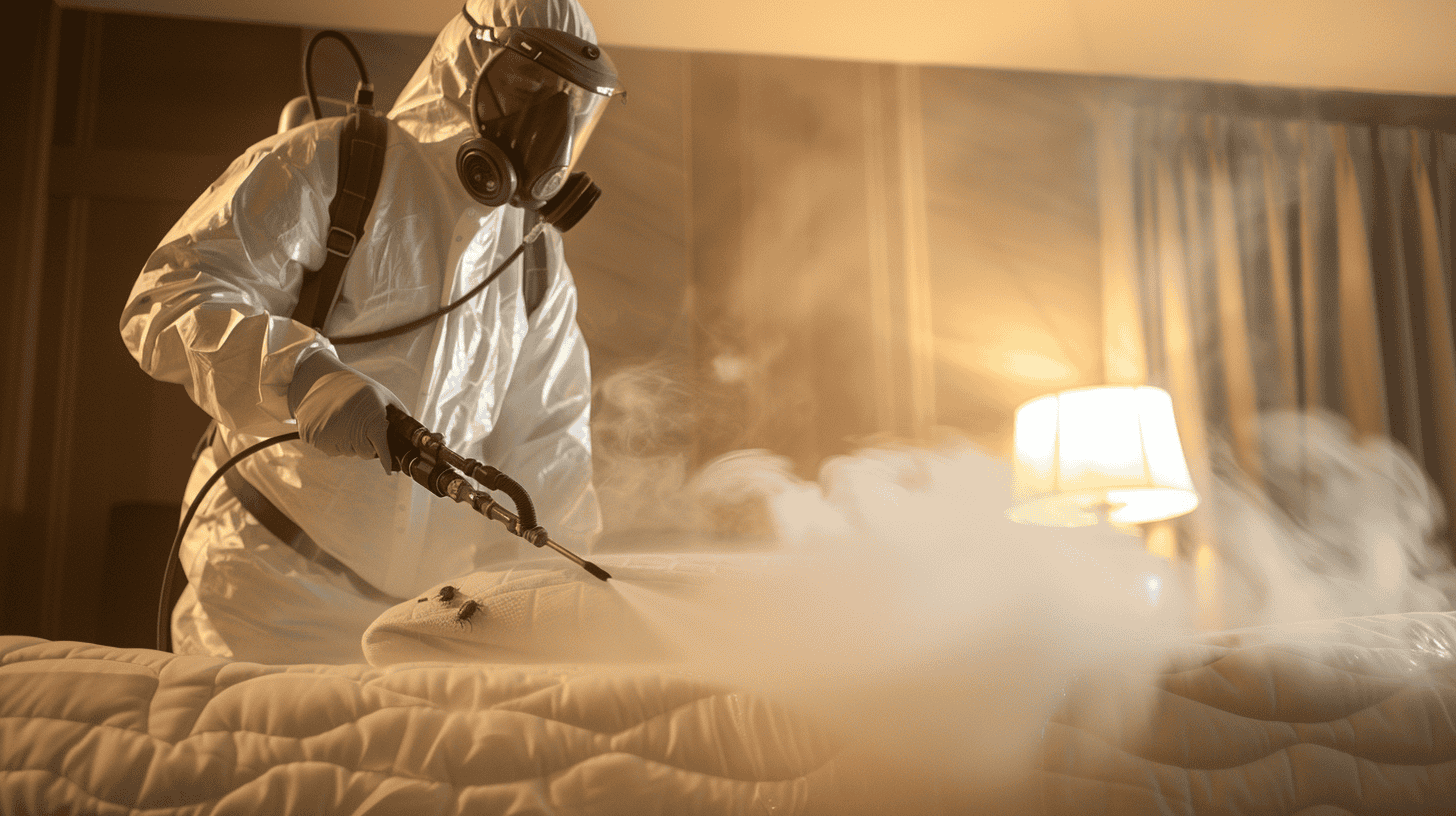
Bed bug extermination usually follows the same sequence: inspection, preparation, treatment and at least one follow-up check. The details below explain what to expect at each step. For a closer look at the technician's work, read what exterminators do for bed bugs.
Inspection
Inspection confirms that you have bed bugs and shows how far they have spread. The technician checks the mattress, box spring, bed frame, headboard and nearby furniture first, then baseboards, outlets and other rooms. Some companies use detection dogs. UC IPM advises checking that a canine team has third-party certification and that any alert is confirmed by a trained professional's inspection.
Preparing Your Home
Preparing your home lets the treatment reach every hiding spot. You will usually be asked to empty drawers and closets, wash and dry bedding and clothing, bag belongings, and move furniture away from walls, following the company's own checklist. Our step-by-step guide on how to prepare for bed bug treatment walks you through it.
Treatment Day
Treatment day depends on the method. A heat treatment is usually one full day on site, and one Toronto company reports about 6 to 8 hours (commercial). Pets, houseplants and heat-sensitive items must be out of the treated area during heating and cool-down. An insecticide visit is shorter, but you still leave the home while products are applied and dry.
Time Away From Home
Time away from home after an insecticide treatment is set by the product label and the company. Quebec's government advises waiting at least 6 hours before returning, 12 hours for people with respiratory problems or allergies and for children, and 24 hours for babies up to 12 months, young children not yet walking and pregnant women. It also advises not walking barefoot in treated areas for at least 48 hours.
Follow-Up Visits
Follow-up visits catch bed bugs that hatch after the first treatment. Health Canada notes that eggs are laid in cracks and other hidden locations, which is why chemical programs often run over two or three visits spaced about two weeks apart, as Canadian companies describe (commercial). Heat treatment is often a single visit followed by a reinspection. Our guide on how long bed bug treatment takes covers typical timelines.
After Treatment
After treatment, you may still see a few bed bugs for several days as survivors cross treated surfaces. Keep vacuuming often, keep the mattress encasement on for a year, and check interceptors and bed seams regularly, as Health Canada and UC IPM recommend. Read what to do after bed bug treatment for the full checklist.
How Do You Choose a Bed Bug Pest Control Company in Canada?
Choosing a bed bug pest control company in Canada usually starts with checking its provincial pesticide licence (the Government of Quebec suggests checking its permit), then comparing experience, the treatment plan and the warranty. Health Canada suggests finding operators through the Canadian Pest Management Association or your provincial pest management association.
Provincial Licence
A provincial licence generally shows the company is allowed to apply pesticides in homes, and the Government of Quebec says to check it. Requirements differ by province:
- Ontario: unless exempt, anyone applying pesticides commercially needs a pesticide exterminator licence (structural extermination is one class), and the business needs an operator licence.
- Quebec: the company should hold a C5 or D5 extermination permit and its employees a CD5 certificate. You can check both in the Registre public de la Loi sur les pesticides (in French).
- British Columbia: the province certifies structural pesticide applicators for pest control in buildings.
Ask for the licence number and check it with your province before the first visit.
Bed Bug Experience
Bed bug experience matters because bed bugs often need more than one spray, and the US EPA says treatment can take weeks to months. UC IPM recommends companies that have handled bed bugs before, since they are more likely to have access to the most effective monitoring techniques and products. Ask how many bed bug jobs the company does and which methods it uses for homes like yours.
Written Treatment Plan
A written treatment plan should list the methods, the products and their PCP numbers, the number of visits, your preparation tasks and how long you must stay out. Having it in writing lets you compare quotes fairly and holds the company to the follow-ups it promised.
Warranty
A warranty tells you what happens if bed bugs come back. Canadian companies advertise terms such as a 90-day warranty on heat treatment or a 100-day guarantee with free re-treatment (commercial). Read the conditions: many warranties require you to follow the preparation list and allow the follow-up visits.
Price Quotes
Price quotes vary with the size of your home, the method and how far the bed bugs have spread, so get more than one. As an example, one Toronto company lists $250 to $600 per room for conventional treatment and packages from $900 for a whole unit, and states that its prices can vary (commercial). Our guide to bed bug exterminator cost explains what drives the price. You can also get a quote from a recommended local exterminator through Pest Agent's referral form.
Questions to Ask
Questions to ask before hiring cover the licence, the methods, the number of visits, the warranty and your preparation tasks. Our list of questions to ask a bed bug exterminator gives you the full checklist to bring to each quote. For more guides, visit the bed bug hub.
Frequently asked questions
Can I get rid of bed bugs myself without an exterminator?
A very small, early problem can sometimes be controlled with hot drying, steaming, vacuuming and encasements. Health Canada still strongly recommends a licensed professional, because bed bugs can hide deep in cracks and some populations resist household sprays. Never use foggers, ozone generators or products without a PCP number.
How many treatments does it take to get rid of bed bugs?
It depends on the method and the size of the infestation. Heat treatment is often a single day, usually followed by a reinspection. Insecticide programs usually take two or more visits, with a follow-up 10 to 21 days after each treatment according to Purdue University Extension, so newly hatched bed bugs are caught.
Is heat treatment better than chemical treatment for bed bugs?
Heat can kill all life stages in about one day and leaves no residue, but it needs careful preparation and leaves no lasting protection. Residual insecticides, which Purdue University Extension calls a practical control, can keep working between visits. Many exterminators combine both, since Penn State Extension says programs that combine chemical and mechanical approaches are effective.
Why am I still seeing bed bugs after the exterminator came?
You may see a few bed bugs for several days after treatment, because survivors must cross treated surfaces before they die and eggs can hatch later. If you still see live bugs after the follow-up visits, call the company back under its warranty.
Do I have to throw out my mattress if I have bed bugs?
Usually not. A mattress can be treated and then sealed in an encasement, which Health Canada suggests keeping on for a full year. Throw out only items that cannot be washed, heated or steamed, and ask the exterminator how to remove them without spreading bed bugs.
Dealing with bedbugs right now?
Answer a few short questions and we pass your request to a pest control company ranked near you.
Get a free quote